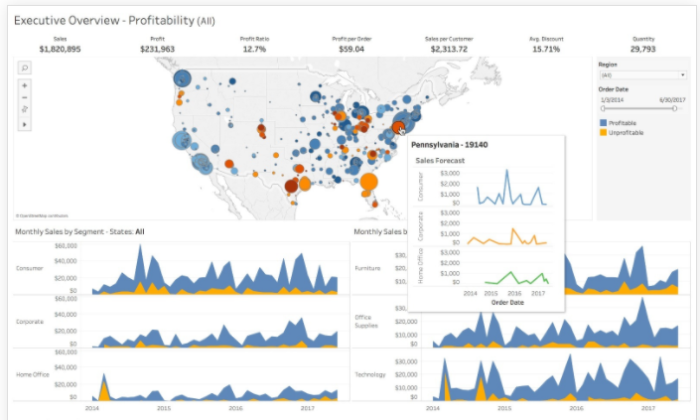

The impact of the right image in a conference room cannot be overstated. It has the power to sell a new client, gain approval from your boss, and unite your team. Data visualization tools have the ability to transform complex data sets into clear, compelling visuals that speak volumes.
Tableau Review: The Ultimate Choice for Enterprises
Tableau stands out as a top-tier business intelligence software with exceptional data visualization capabilities. While it may not be the most budget-friendly option, Tableau offers an intuitive user interface and the flexibility to explore various data sources effortlessly.
One of Tableau's key strengths lies in its user-friendliness, making it accessible for middle managers and C-level executives without the need for constant assistance. Additionally, Tableau fosters a data-driven culture within organizations by providing secure, enterprise-grade governance tools and on-premises deployment options.
Some standout features of Tableau include the ability to combine diverse data sources without coding, drag-and-drop statistical analysis, optimization of dashboards for all screen sizes, and AI-powered data analysis. With a pricing structure that accommodates different user roles, Tableau offers a cost-effective solution for large organizations.
Infogram Review: Enhancing Collaboration Efforts
Infogram emerges as an intuitive data visualization tool that empowers users to create stunning reports, slides, dashboards, and social media visuals effortlessly. With a user-friendly interface and drag-and-drop functionality, Infogram enables teams to produce consistent, visually appealing content in a collaborative environment.
Teams can leverage Infogram's extensive design capabilities, including a vast library of stock images, interactive charts, maps, and design themes. The tool also offers seamless data integration with popular platforms like Google Analytics, MySQL, and more. Pricing options cater to individuals, businesses, teams, and enterprises, ensuring scalability and flexibility.

Plecto Review: Driving Sales Team Performance
Plecto is designed to promote a data-driven team culture by providing real-time visibility of key performance indicators (KPIs) through interactive dashboards. What sets Plecto apart is its gamification feature, allowing users to create contests based on KPI benchmarks, fostering competition and motivation among team members.
With customizable KPIs, integrations with leading databases, and notifications for performance milestones, Plecto is tailored for sales teams seeking to enhance transparency and motivation. The tool offers different pricing plans to accommodate varying team sizes and requirements.
Datawrapper Review: Empowering DIY Data Visualization
Datawrapper offers a user-friendly approach to creating interactive and responsive charts, maps, and tables without the need for extensive technical expertise. Popular among companies like The New York Times, Datawrapper enables users to produce captivating visualizations to convey complex data effectively.
Key features of Datawrapper include seamless data import, a variety of chart types, live-updating graphics, and collaborative tools. While the free version caters to internal use, premium plans unlock advanced customization options for public-facing visualizations.
Highcharts Review: Interactive Visualizations Made Easy
Highcharts is a versatile tool designed to help developers integrate interactive charts into web and mobile projects seamlessly. With a focus on extensibility and compatibility, Highcharts offers a range of features, including multiple map types, export options, and mobile optimization.
For personal, non-commercial, or non-profit use, Highcharts provides free access to its products. Businesses can explore custom pricing plans tailored to their specific needs and requirements, ensuring a tailored solution for interactive visualizations.

Choosing the right data visualization tool depends on your unique requirements and business objectives. Whether you prioritize enterprise capabilities, collaboration features, sales team performance, DIY visualization, or interactive visuals, there is a tool to suit your needs.
Frequently Asked Questions
What is an example of search engine marketing?
Search Engine Marketing is a key component of digital marketing. SEM includes paid advertising, sponsored ads, display ads and paid inclusion. It also includes search engine optimization (SEO), mobile marketing, social media marketing, video advertising, mobile advertising, and other related services.
What are the major types of marketing?
Marketing is the act or communication of ideas, values and messages to consumers. We often use the term marketing interchangeably with advertising. Marketing does not just include advertising. Marketing is all communication that promotes and markets a product or service.
Three key components of marketing are branding, promotion and distribution. Branding is the way a company presents itself to its target audiences. Promotion is the act of getting attention for your brand by using paid advertisements, free promotions, and public relations activities. Distribution is how you get your message across to your target audience. Although distribution can be done using traditional methods like television, radio or print, it is now easier with the advent of new technologies.
What are the 4 functions that make up marketing?
Marketing is the art of creating demand for products and services.
It communicates information about an organization's offerings, and values and how those affect customers' lives.
Marketing stimulates interest, creates awareness, and finally drives action (or purchase), in response to an invitation.
The following are the four functions that marketing has:
- Create Demand – This involves building relationships with potential buyers to convince them of the value in your product or service.
- Stimulating Interest: This refers to increasing awareness among consumers about your product/service.
- Building Awareness – This refers to making sure consumers are familiar with your product and services, as well as why they might be interested in buying them.
- Driving Action – This is ensuring that customers make purchases once they are aware of your products or services.
How does marketing fit in with business strategy.
Marketing is an essential part to any business strategy. Without marketing, no one will know what your company has to offer. Marketing is not possible without sales. Marketing is an essential part of any business strategy.
However, not everyone is aware of the importance and value of marketing. Marketing is often seen as a matter of spending money on advertising campaigns. Marketing is much broader than that. Marketing includes everything you do in order to communicate the company's identity, position and value in the marketplace.
When you think about your business, ask these questions: What image am I trying convey? What image will I project to my customers? How can I best present myself to the world
If you don’t answer these questions you haven’t thought of marketing yet.
What is the difference of advertising and marketing?
Advertising is a form or communication that promotes products, brands, and services. Advertising is usually accompanied by a clear call for action, such “Buy Now!” Or “Click Here.”
Marketing is on the flip side, it's a way for your company to communicate its mission, vision, values, and other information to potential customers. Marketing helps to build relationships with prospects and customers.
If you sell shoes online, for example, marketing can be used to tell the story of who you are and what your offer. Talk about your values, philosophy, and dedication to quality. You might share customer testimonials. You could even organize an event in which you give away shoes for free to encourage people to visit you website.
Marketing is simply telling stories. Advertising is about selling products.
What are the 4 types?
Marketing can be divided into 4 categories: Direct Mail Marketing (Traditional Advertising), Public Relations (Public Relations) and Digital Marketing. Each has different objectives, and each should be used for specific purposes. These can be combined to help you reach your goals.
Statistics
- Meanwhile, a PartnerPath poll found that co-marketed ads help 68% of consumers arrive at a buying decision before even speaking to a salesperson. (influencermarketinghub.com)
- Companies that use personalization are seeing revenue increases ranging from 6-10%. (blog.hubspot.com)
- In 2017, 34% of marketers cited co-branding as the most effective way to increase the number of email subscribers. (influencermarketinghub.com)
- A poll earlier this year found that 14% of older Gen Z's had bought an item in the previous six months based on an influencer's recommendation. (influencermarketinghub.com)
- According to statistics, 60% of online shoppers worldwide actively search for coupons before purchasing from a virtual shop. (influencermarketinghub.com)
External Links
influencermarketinghub.com
statista.com
moz.com
- SEO Learning Center, Moz
- [Case Stud] How Moz Ranked #1 in Search Engine Optimization for a High-Volume Keyword In Under 3 Months
blog.hubspot.com
How To
What's your marketing strategy?
Are you familiar with the expression, “If they build it, they will follow”?
Well, you're wrong.
It takes work to build something, but it is not enough to attract customers. To grow your business, you must use Internet Marketing Principles to reach your target audience.
Internet Marketing Principles is a set of guidelines used by marketers for creating websites, blogs or email campaigns that generate leads and sales.
If you sell handmade jewelry online, these Internet Marketing Principles will help you drive traffic to your website, capture emails and close the sale.
These are just a few examples of Internet Marketing Principles.
- Content is king. You need to create compelling content. Copying someone else's content can cause you to lose credibility and be seen as a reliable source of information.
- Establish trust – More people trust recommendations from close friends and family than advertisements or Adsense. You should only recommend products that you trust.
- Personalize – People prefer to speak to people, not robots. Your website should look human and not robotic.
- Offer value – People don't give away anything unless they feel they are receiving something worth their time. In return for their contact information, you can offer something of value.
- Tell stories – Stories are powerful tools for connecting audiences. They help you tell your story and connect with your audience.
- Giveaways – Give away products to increase brand awareness and build loyalty.
- It is important to use call-to-action buttons because they encourage users to take action.
- Test everything – Testing is critical to ensure your website works properly before launching it live.
- Keep it simple. Simple is always better than complicated. Keep it as simple as possible. The easier your website is to maintain and update, the better.
- Set a clear goal. This will make it easier for you to measure your results.
- Measure everything – It is essential to track your progress toward your goals in order to improve your marketing efforts.
- Focus on conversion. Conversion refers to turning browsers into customers.
- Get feedback. Feedback can help you improve your marketing efforts.
- Track results – By keeping track of your results you can identify areas where you need to improve.
- Repeat – repetition creates momentum
- Optimize Your Marketing Efforts – Optimization ensures your marketing efforts are efficient.
- You must be consistent. Your brand will always be remembered.
- Reward yourself – Rewards motivate you to continue doing well.
- Learn from other people – This is one way to avoid making the exact same mistakes.
- Never stop learning. Always look for new ideas and techniques.
- Think long-term – Long-term thinking is necessary to achieve sustainable growth.
- Trust your intuition – Sometimes your intuition is the best tool to help you navigate your way through life.
- Every day is a test. While mistakes are inevitable, they can teach us valuable lessons that we wouldn't otherwise be able to learn.
- Learn to understand your weaknesses. Understanding your strengths will give you an insight into how you can overcome obstacles.
- Don't be discouraged. Everybody fails at some point. But don't let failure discourage you. Just try again.
- Take risks – Sometimes it's necessary to take chances in order for you to move forward.
- Enjoy the journey. To live a happy life, it is important to enjoy the journey.
- Be passionate – Passion fuels motivation.
- Be who you really are. It is essential to build relationships.
- Know yourself – Self-knowledge can be essential for self-improvement.
- Find your tribe. It's important to build a support network of like-minded people.
- Vision boards are great tools to visualize your future.
- Ask questions. Questions lead to knowledge.
————————————————————————————————————————————–
By: 3005
Title: Data Visualization Tools: A Comprehensive Review
Sourced From: internetlib.org/best-data-visualization-tools/
Published Date: 7/18/2021 5:58:54 PM