
Customer relationship management (CRM) software plays a crucial role in providing excellent service and gathering valuable insights into your clients' needs. It streamlines daily tasks for employees, ensuring they have all the necessary information at their fingertips.
Hubspot Review: The Best Free CRM Software
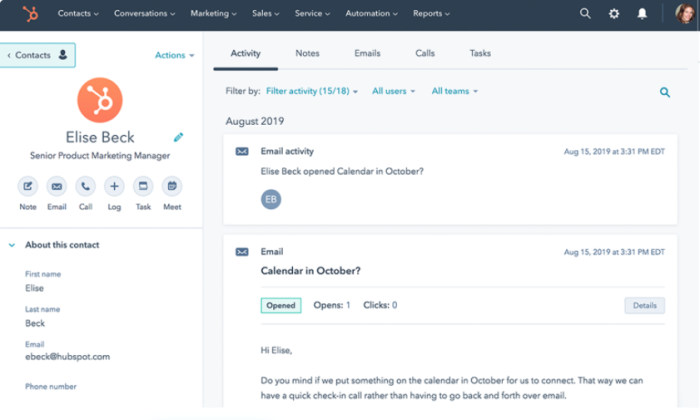
Hubspot offers a free CRM software that provides deep insights into customer behavior. It allows you to track email opens, monitor website interactions, and offers role-specific solutions for various departments within your company. The free plan includes essential features like contact management, email scheduling, and live chat, making it a standout choice.
Salesflare Review: Best Lead Management Tools for Small Business
Salesflare excels in lead management tools, automatically gathering contact information and tracking interactions. It simplifies the buyer's journey, allowing for seamless hand-offs between team members and timely follow-ups. With features like team-wide timeline views and personalized email campaigns, Salesflare is ideal for small B2B sales teams.
Zoho CRM Review: The Best for Small to Midsize Businesses
Zoho CRM stands out as an all-in-one solution tailored for small to midsize businesses. With seamless integration with other Zoho tools and a user-friendly interface, it offers essential features like lead management and document sharing. The paid plans are affordable and include advanced CRM capabilities, making it a comprehensive choice for growing businesses.
Freshworks CRM Review: The Best CRM for Sales Teams
Freshworks CRM is designed specifically for sales teams, focusing on lead management and relationship-building. It simplifies the sales process with built-in email and phone systems, along with advanced features like lead scoring and website visitor tracking. With industry-specific solutions and a range of pricing options, Freshworks CRM caters to businesses of all sizes.
Creatio Review: The Best Enterprise-Grade CRM Software
Creatio offers enterprise-grade CRM solutions for sales, marketing, and customer service teams. With features like visual campaign design and personalized email marketing, it streamlines multichannel marketing efforts. The pricing is flexible based on contacts and emails per contact, making it a scalable choice for large operations.

Salesforce Review: The Best CRM Software for Versatility
Salesforce is renowned for its versatility, offering specialized CRM solutions for various industries and business sizes. With customizable apps and features for sales, marketing, IT, and customer support, it adapts to meet diverse business needs. The pricing plans cater to different business requirements, making Salesforce a comprehensive choice for businesses of all sizes.
Choosing the right CRM software depends on your business size, specific challenges, and required features. Consider factors like basic and advanced CRM features, third-party integrations, and industry-specific solutions to make an informed decision. Start with a free trial or demo to see which CRM software aligns best with your business goals.
Frequently Asked Questions
What are some of the best digital marketing techniques I can do from my home?
Digital marketing is a cost-effective way to reach customers that spend most of their time online. It's also an excellent opportunity to generate leads for your business.
You can promote your brand using social media platforms, such as Facebook, Twitter and LinkedIn. You can also use email marketing tools to send emails to potential clients and prospects.
There are many other marketing options that you can use to promote your product or services using digital media.
As long as you know how to effectively use these channels, getting started should be no problem.
What are the main types of marketing?
Marketing is the process of communicating ideas and values to consumers. Marketing is often used interchangeably with advertising. Marketing is more than advertising. Marketing is all communication that promotes and markets a product or service.
Three key components of marketing are branding, promotion and distribution. How a company is identified to its target audience is called branding. Promotion is the act that draws attention to your brand by using paid ads, free promotions, or other public relations efforts. Distribution is the delivery of your message to your target audiences. You can do it through traditional media like radio, television, print, or email. However, new technologies make this easier than ever.
What are the four functions marketing serves?
Marketing is the art of creating demand for products and services.
It communicates information about an organization's offerings, and values and how those affect customers' lives.
Marketing can also increase interest in an offering and build awareness. Finally, it drives action (or buy) in response a invitation to act.
Marketing can be divided into four functions.
- In order to create demand, you must build relationships with potential buyers in order to convince them that there is value buying your product or services.
- Stimulating Interest – This involves increasing consumer awareness of your product or service.
- Building Awareness – This refers to making sure consumers are familiar with your product and services, as well as why they might be interested in buying them.
- Driving Action – This is ensuring that customers make purchases once they are aware of your products or services.
What are the five marketing concepts?
These five marketing concepts are:
- Branding – A brand is an image that people have for you. It's what people associate with you when they hear your name. It is important to have a consistent brand identity across all media.
- Your position is how you present yourself to your market. What does it mean to be who you are and why should people care?
- Message – This is your message's content. What is your point What is your point?
- Marketing mix – This combines channels, pricing, and promotions to deliver your message to your target audience.
- Measurement – How do I measure success?
What are some direct marketing examples?
Direct Marketing Examples include postcards, brochures, flyers, e-mails, etc.
Direct marketing helps you reach people at home or on the go. It's the best way to communicate with customers who have already chosen your product or service over another brand.
You should know which message will appeal to your target market the most.
Finding out what your customers want is key to delivering it.
Direct marketing is a great way to promote your brand. You could mail catalogs to customers, or place ads in local newspapers.
You could also create a separate mailing list for your customers. A good contact database will make it easy to add subscribers to your mailing list.
Last but not least, ask existing customers if promotional materials are something they'd be interested in receiving. Special offers may be offered by some companies to get discounts.
Social Media Marketing is an excellent way to market your business online. It is a great tool to increase brand awareness, generate leads, and sell products. Here are five methods to leverage social media marketing to increase your business.
- Make a Facebook fan page – This will allow you to interact directly on Facebook with your customers. You can upload photos, videos and other files.
- Twitter Promote Your Business – Twitter offers a great way to share information and connect people. Use hashtags to increase visibility.
- Post Videos on YouTube – Uploading videos is very popular because many people enjoy watching them. If someone likes what they see, they may click to visit your website.
- Host Live Events. Organizing live events allows potential clients to meet face-toface. They can ask about your products and services.
- Respond to Customer Reviews. Positive reviews can build trust with clients and encourage repeat sales. You should respond quickly to negative comments.
Are there any risks associated with digital marketing?
Yes, there are several risks involved in digital marketing.
You must first protect your online reputation through being cautious about what you share on social media.
You must also ensure that your content is original and doesn't infringe upon any other intellectual property rights.
In addition, you risk losing control of your brand image if you do not monitor your online presence closely.
You could also be vulnerable to identity theft if your personal details are used without your consent.
How to Protect Your Online Image
- Take care of what you say on social media
- Ensure that All Content Is Original, and Doesn't Infringe upon Any Other Intellectual Property Rights
- Monitor Brand Image
- Use Strong Passwords
- Avoid Using Personal Details Without Permission
- Report Unauthorized Activities Immediately
- Don't Post Photos Of Yourself Or Others In A Disturbing Way
- Never give out your Social Security Number
- Keep Up With The Latest News
- Stay Away from Scams
- Secure Password
- Always Be On The Lookout for Updates
- Don't share too much information
- Take care when you give credit card numbers
- Avoid sending money by E-Mail
- Check For Fake Websites
- Remember That Bad Reviews Can Hurt Your Business
- Check Your Credit Reports Regularly
- Keep an eye on your privacy settings
- Ask Someone Who Knows You Well Before Sharing Something
Statistics
- From 2020 to 2022, eMarketer predicts that digital marketing will grow by 36% and take up 54% of marketing budgets! (marketinginsidergroup.com)
- This allows us to deliver CPCs that are 80% less than average and CTRs 4-5 times higher than average. (marketinginsidergroup.com)
- A poll earlier this year found that 14% of older Gen Z's had bought an item in the previous six months based on an influencer's recommendation. (influencermarketinghub.com)
- According to statistics, 60% of online shoppers worldwide actively search for coupons before purchasing from a virtual shop. (influencermarketinghub.com)
- Today, 81% of brands around the world have affiliate programs. (influencermarketinghub.com)
External Links
moz.com
- SEO Learning Center Moz
- [Case Study] How We Ranked #1 for a High-Volume Keyword in Under 3 Months – Moz
neilpatel.com
- How to Use Search Engine Optimization to Build Your Brand
- Marketing Automation: Examples & Tools (2022)
hubspot.com
influencermarketinghub.com
How To
How can you tell if your branding efforts are working?
Asking customers directly is the best method to measure your success. Ask them to rate your brand. What do they enjoy most about your business? What do they dislike? What are you doing to improve your business?
You can also do surveys on social media websites like Facebook and Twitter. You can simply ask your followers how they rate your brand. Then analyze the results to determine which aspects of your brand are most successful.
Customer reviews are also available. When they are satisfied or dissatisfied with a company, people love to express their opinions. You can learn a lot from these comments about your brand.
These are some ways to improve your brand.
- Be consistent. Keep your marketing materials consistent. Your message must remain consistent across all channels.
- Multichannel marketing is a good idea. To promote your brand, you should use email, social media, websites, and other digital communication channels.
- Make sure you're giving your customers what they want. You must deliver on your promises of free shipping if it is offered. If you don't deliver on your promise, customers might abandon you.
- Your brand is not just a logo. Your brand represents everything about your company. It is important to take the time necessary to create a cohesive image.
- Ask your customers for feedback. The sooner you get feedback from your customers, the better.
- Test different messages. You might discover that one message is better than the rest. Or perhaps you have two similar messages and one gets more attention than the other. Whatever the reason, it's important to track your stats to see which message performs best.
- Seek out ways to improve the brand. Is there a way you could improve your brand? You might add more videos to the website. You might also consider adding customer testimonials to your blog posts.
- Plan. Once you've decided on your goals and objectives, you'll need to develop a strategy for achieving those goals. You will need to create a timeline that will help you reach each objective. This includes setting milestones to track your progress.
- Measuring your results is important. As soon as you reach your goal, stop measuring. Instead, create a system that will track your progress over time. By doing this, you will always be able to see if you are moving towards your ultimate goal.
- Repeat! You've built a strong foundation for your brand. Now you want to keep building on it. Consider hiring someone to help you if your marketing efforts aren't keeping up.
- Keep your eyes open for the positive. Negative feedback is something you should never ignore, but you shouldn't dwell too much on it. Instead, focus on the positive aspects of this feedback and how you can make it work for your brand.
- Make the most of technology. Technology has given us many options that we didn't know existed. Why not make the most of them? For example, you could create a mobile app for your brand.
- Try thinking outside the box. There's nothing wrong with trying something new. It's okay to try something new, but don't forget to think first.
- Have fun. Marketing isn't supposed to be stressful. It is sometimes called “funmarketing”. Try to have fun while you work.
- Know when to quit. It's okay when you feel you have done everything you can. But don't give up too early. Sometimes, it is necessary to stay with something until you reach your desired results.
- Don't forget about consistency. Consistency and consistency are key to success. Spend some time creating a schedule for you brand.
- Be patient. You will take time to build a successful brand. And, it won't happen overnight.
- Keep learning. Marketing is constantly changing. Marketing is constantly changing. Make sure to keep up with the latest developments by reading blogs and participating in webinars.
- Never stop learning. You can still learn from others even after you have achieved your goal.
- Enjoy the journey. Marketing is fun. Marketing doesn't have to be boring.
————————————————————————————————————————————–
By: 2864
Title: The Best Customer Relationship Management (CRM) Software for Your Business
Sourced From: internetlib.org/the-best-crm-software-in-depth-review/
Published Date: 7/7/2021 4:47:21 PM