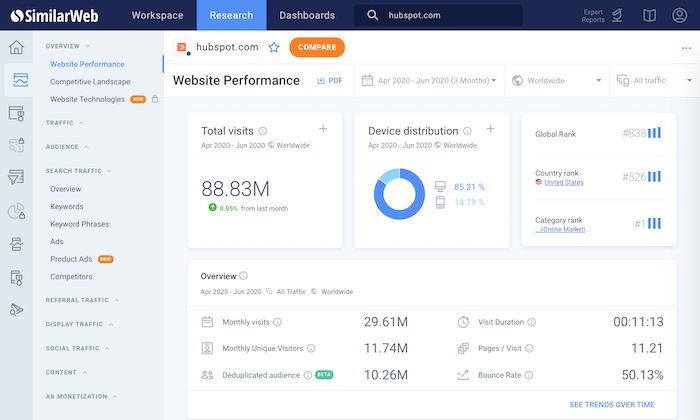

When starting in marketing, the focus on generating traffic seems paramount. Comparing stats of major players like HubSpot, with their 29.61 million monthly visitors, to NeilPatel.com's 8.717 million, illustrates the importance of targeting the right audience. Understanding and defining your target audience is crucial for business success, especially for startups.
Understanding Target Audience
A target audience represents the specific consumer segment a business aims to reach through its marketing efforts. The goal is to target individuals sharing characteristics, interests, and problems similar to the ideal customer, ultimately driving sales. Identifying and focusing on the right audience leads to higher conversion rates and business growth.
Target Audience vs. Persona
While the target audience defines the general consumer group, personas are detailed profiles of ideal customers. Personas include personal characteristics, lifestyle, interests, and social engagement, providing a deeper understanding for tailored marketing strategies. Distinguishing between target audience and personas is essential for effective marketing campaigns.
Significance of Target Audience Identification
Misidentifying the target audience can lead to ineffective marketing efforts. Understanding customer needs, preferences, and behavior is crucial for developing tailored marketing strategies. By knowing the target audience, businesses can conduct precise keyword research, leading to increased revenue generation and improved marketing ROI.
Defining Your Target Audience: Key Questions
1. Who Are They?
Identify individuals engaging with your brand on social media or purchasing from your company.
2. What Are Their Challenges and Desires?
Understand the problems and desires of your audience to offer relevant solutions.

3. Where Do They Seek Information Online?
Identify the preferred online platforms and communication channels of your target audience.
4. What Unique Value Do You Provide?
Define the benefits and competitive advantages of your product or service for your audience.
5. What Negatively Impacts Their Attention?
Consider aspects that may deter your audience and focus on addressing their concerns.
6. Who Do They Trust?
Building trust with your target audience is crucial for successful marketing and customer retention.
Customized Content Creation for Target Audience
Creating personalized content for the target audience enhances engagement and conversion rates. By using tools like Ubersuggest to identify relevant topics, focusing on long-tail keywords, and aligning content with different stages of the marketing funnel, businesses can effectively reach and resonate with their audience.
Target Audience FAQ
1. How do you define your target audience?
Consider demographics, behaviors, preferences, and online habits to define your target audience.

2. What is an example of a target audience?
For instance, women aged 20-30 in Los Angeles with a passion for fashion and decor, and a specific income range.
3. Why does a target audience matter?
Targeting the right audience optimizes marketing efforts, increases conversion rates, and maximizes ROI.
Identifying your target audience is the foundation of a successful marketing strategy. By understanding who your audience is and creating tailored content and strategies, you can effectively engage and convert leads into loyal customers.
Frequently Asked Questions
What are some direct marketing examples?
Direct Marketing Examples include postcards, brochures, flyers, e-mails, etc.
Direct marketing helps reach people from anywhere, at any time. It's the best way of communicating with customers who have already selected your product/service over another.
Know what type of message would be most appealing to your target markets.
Find out what your customer needs, then provide it.
There are many ways to use direct marketing to promote your business. You could mail catalogs to customers, or place ads in local newspapers.
You could also create a separate mailing list for your customers. With a solid contacts list, you can add new subscribers easily to your list.
Ask current customers if their would like to receive promotional materials. Many companies offer discounts for those who sign up to special offers.
What kind of eCommerce Marketing Strategy Should I Follow?
There are three main types of eCommerce marketing:
- Direct marketing
- Search Engine Optimization (SEO).
- Social Media Marketing
Direct marketing involves sending emails directly from the source to potential customers. These emails could contain coupons, discounts, special offers, etc. This type of marketing aims to build customer loyalty and trust.
Search engine optimization improves the rank of your website on search engines such Google, Yahoo, Bing, etc. When your website appears at the top of search results when people type in keywords related to your product, you'll get more visitors.
Social media marketing is done using websites like Twitter, Facebook and Pinterest. You can connect with your target audience. It is free, simple to set up and highly effective.
Each method has its advantages and disadvantages. SEO is time-consuming and requires effort while direct advertising is easy to do. It is possible to miss the entire benefit of eCommerce marketing if your focus is on one method. We encourage you to combine multiple marketing channels.
To promote your products, you can send emails and get high rankings in search engine results. Or you could advertise on social media and then link to your site from those pages.
There are many ways to market an eCommerce store. Make sure you choose the right work for your business and stick with them. Best of luck!
What are the five main marketing concepts?
The following five marketing concepts can be used:
- Branding – Your brand is the image people associate with you. It's what people associate with you when they hear your name. You must create a consistent brand identity across all media.
- Positioning – Your positioning is how you position yourself within your market. How do you describe who you are, and why should anyone care?
- Message- This is your message's main content. What is the point of your message? Why should someone buy from you?
- Marketing mix – This is a combination of channels, pricing and promotions that enables you to reach your target audience.
- Measurement – How do you measure success?
How does search engine optimization work?
Search Engine Marketing (SEM), one of the most important components of digital marketing, is essential. SEM includes paid advertising, sponsored ads, display ads and paid inclusion. It also includes search engine optimization (SEO), mobile marketing, social media marketing, video advertising, mobile advertising, and other related services.
Statistics
- Today, 81% of brands around the world have affiliate programs. (influencermarketinghub.com)
- Companies that use personalization are seeing revenue increases ranging from 6-10%. (blog.hubspot.com)
- Meanwhile, a PartnerPath poll found that co-marketed ads help 68% of consumers arrive at a buying decision before even speaking to a salesperson. (influencermarketinghub.com)
- This allows us to deliver CPCs that are 80% less than average and CTRs 4-5 times higher than average. (marketinginsidergroup.com)
- From 2020 to 2022, eMarketer predicts that digital marketing will grow by 36% and take up 54% of marketing budgets! (marketinginsidergroup.com)
External Links
moz.com
- SEO Learning Center- Moz
- [Case study] How we ranked #1 in a high-volume keyword in under 3 months – Moz
neilpatel.com
hubspot.com
influencermarketinghub.com
How To
Top Brands Offer Online Marketing Tips & Tricks
When creating content for online marketing, ensure it's relevant to your audience. Your blog posts should not be about products or services that aren't important to your audience.
Your website should be focused on fashion accessories. Not general web design tips.
Promote your business using social media platforms, such as Facebook, Twitter or LinkedIn. Businesses can use social media platforms to communicate with customers and share information.
The social media platforms also offer a great opportunity for clients to connect with each other.
Create content that engages users and encourages them to share content with their friends. Shared content can reach more people and increase traffic to your site.
Regular updates keep your content relevant. Posting daily or weekly is better than posting once a month.
Posted content is more popular because readers expect new content.
Your content should contain links to your homepage. This makes it easier for your visitors to find additional resources.
Make sure your content is mobile-friendly. Mobile devices now outnumber desktop computers. According to a survey, more that half of internet users access websites from their smartphones.
Test it on various smartphone and tablet browsers to ensure your content looks good when viewed on small screens. In conclusion, the mobile-first approach should be a no-brainer for any website owner or developer.
It's not just about aesthetics, either. Mobile sites convert more than desktop websites. Not only are they easier to navigate, but they also tend to load faster because of the smaller size of the site.
Create content that matters to your audience.
————————————————————————————————————————————–
By: 2725
Title: Guide to Identifying Your Target Audience
Sourced From: internetlib.org/how-to-find-your-target-audience/
Published Date: 6/23/2021 1:21:22 AM