
Hey there, looking to create a website without diving into the coding world? Content management systems (CMS) are your best friends. They empower you to manage website content hassle-free, no coding skills required. Say goodbye to JavaScript, CSS, and HTML complexities!
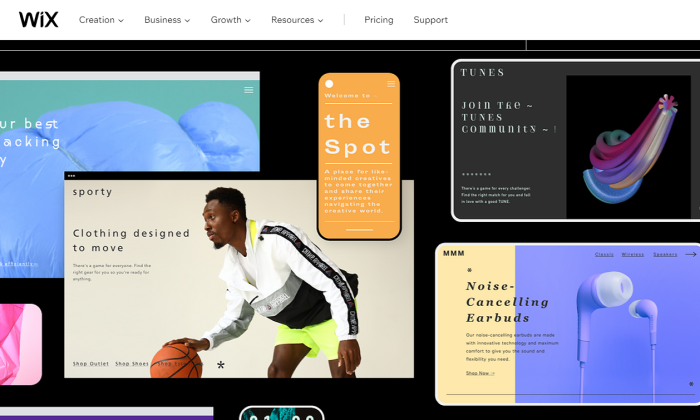
#1 – Wix: The Go-To for New Websites
Imagine building your dream website without breaking a sweat. That's Wix for you! With its drag-and-drop interface, you can craft your site effortlessly. Here's why Wix rocks:
- Choose from 500+ free templates
- SEO and mobile-friendly
- Create password-protected pages
- Set up eCommerce with ease
- Enjoy blog management and free hosting
Why Wix?
Wix's simplicity and features make it a hit among businesses and online stores. Plus, it starts at just $14 per month!
#2 – Squarespace: The Artist's Paradise
Squarespace is where art meets technology. This all-in-one platform offers stunning designs and customizable templates. Creative souls, this one's for you! What Squarespace brings to the table:
- Free domain registration for a year
- eCommerce tools and marketing features
- 24/7 customer support
For only $12 a month, Squarespace lets you showcase your portfolios and creativity effortlessly.
#3 – Shopify: Ecommerce Made Easy
Ready to dive into the world of online selling? Shopify is your go-to. From product management to marketing, Shopify has your back. Here's why it's a top choice:

- Robust features for online stores
- 24/7 support
- Plans starting at $29 per month
Start strong with Shopify's 14-day free trial and scale your online business seamlessly.
#4 – WordPress: The King of CMS
Powering 38% of the Internet, WordPress is a household name in the website game. From personal blogs to large websites, WordPress does it all. Key features include:
- Customizable designs
- SEO-friendly structure
- Media management tools
Though lacking direct support, WordPress's community and plugins offer endless possibilities for your site's growth.
#5 – Drupal: WordPress's Tough Competitor
Looking for an alternative to WordPress? Drupal's got your back. Known for its advanced content management features, Drupal suits diverse industries perfectly. Dive into Drupal for robust content management!
#6 – TYPO3: The Enterprise's Choice
Enterprises need a robust CMS, and TYPO3 delivers. Multilingual support, scalability, and top-notch performance make TYPO3 a favorite among global corporations. It may not be the easiest, but it sure gets the job done for complex content needs.
Crucial CMS Selection Factors
1. Usability
Choose a user-friendly CMS for smooth content management, even for non-techies.

2. Security
Opt for a secure CMS or integrate reliable security plugins for protection.
3. SEO
Pick a CMS with built-in SEO tools or plugin support to boost your site's visibility.
4. Support
Consider the support options available, especially for open-source CMS platforms.
5. Customization
Check the CMS's customization level to ensure it aligns with your site's unique needs.
In a Nutshell
Choosing the right CMS is key to your website's success. Whether you opt for Wix, Squarespace, Shopify, WordPress, Drupal, or TYPO3, tailor your choice to your goals and user experience. Dive into trials, compare features, and think long-term scalability. Your ideal CMS is out there, waiting to elevate your website game!
Frequently Asked Questions
What makes it so important to identify your brand?
Your company's brand is nothing more than a promise you make to your customers. A brand promises benefits and certain qualities that will distinguish your company from others. Your brand is the thing that makes you different from other companies within your industry.
A brand establishes your authority and credibility. Potential customers recognize your logo as a sign that you stand behind your products and services. Because you have earned their trust, they will trust you.
Your company's culture is also part of your brand. Your brand will reflect the passion of your employees for your product/service.
Your brand isn't just words or pictures. It is a promise your company keeps. It's your promise to give value to your clients.
When you set out to develop your brand, you need to consider several factors. First, you need to choose a name which clearly describes the company's mission. Sweet Dreams Bakery, for example, would be a great name for a bakery. For a software company, DreamSpark Software is the right choice.
Next, you'll want to decide how your brand will be represented. Will you use a recognized symbol? Will you use colors that match your corporate look? Will you use logos
You must also think about the perceptions of your target market regarding your brand. Do you present yourself as helpful and friendly? Do you seem trustworthy and professional? Will you seem knowledgeable and experienced?
These are all important questions you should ask before building your brand.
What are the main types of marketing?
Marketing is about communicating ideas, values, or messages to consumers. Advertising and marketing are often interchangeable these days. Marketing encompasses more than advertising. Marketing is all communication that promotes and markets a product or service.
Marketing is comprised of branding, promotion, as well as distribution. Branding refers to how a company identifies itself to its target audience. Promotion is the process of attracting attention to your brand via paid advertisements, promotions that are free, and other public relations activities. Distribution is how your message gets to your audience. Although distribution can be done using traditional methods like television, radio or print, it is now easier with the advent of new technologies.
What is the difference between marketing and advertising?
Advertising is communication that promotes brands or products. Advertising has a clear call of action. For example, “Buy now!” Or “Click Here.”
On the other hand, marketing is a way of communicating your company's mission, vision, and values to potential customers. Marketing helps to build relationships with prospects and customers.
If you sell shoes online, for example, marketing can be used to tell the story of who you are and what your offer. Your history, philosophy and commitment to quality could be discussed. You could even share testimonials of satisfied customers. For people to come to your website, you could offer them a free pair of shoes.
Marketing, or telling stories, is in essence about telling stories. Advertising is about selling products.
Social Media Marketing is an excellent way to market your business online. It is an excellent tool to spread brand awareness and generate leads and sales. Here are five social media marketing strategies to help your business grow.
- A Facebook Fan Page allows you to interact with customers via Facebook. Upload photos, videos, as well as other files.
- Twitter Promote Your Business – Twitter offers a great way to share information and connect people. Use hashtags to increase visibility.
- Post Videos on YouTube. Many people enjoy watching these videos. If people like what they see, they may click on your website.
- Host Live Event – Hosting live events will allow you to meet face to face with potential clients. They can ask questions about your products and services.
- Respond to Customer reviews – Positive customer reviews increase trust and promote repeat purchases. Negative comments should be addressed quickly.
What are the five main marketing concepts?
These five marketing concepts are:
- Branding – Your brand is the image people associate with you. It's what people see when they hear your brand name. A consistent brand identity is essential for all media.
- Positioning – Your positioning is how you position yourself within your market. How do you describe who you are, and why should anyone care?
- Message- This is your message's main content. What is your point What's the point?
- Marketing mix – This is a combination of channels, pricing and promotions that enables you to reach your target audience.
- How do you measure success?
Which are the four types marketing?
Marketing can be broken down into four distinct categories: Direct Mail Marketing, Traditional Advertising and Public Relations. Each of these categories has different goals and should only be used for specific purposes. This will allow you to combine them and reach your goals.
What is an example of search engine marketing?
Search Engine Marketing (SEM), is an essential component of digital marketing. SEM encompasses paid-per click advertising, sponsored link, display ads (paid inclusion), search engine optimization(SEO), social marketing, video marketing and mobile advertising.
Statistics
- From 2020 to 2022, eMarketer predicts that digital marketing will grow by 36% and take up 54% of marketing budgets! (marketinginsidergroup.com)
- According to statistics, 60% of online shoppers worldwide actively search for coupons before purchasing from a virtual shop. (influencermarketinghub.com)
- 81% of brands employ affiliate marketing, and eCommerce sites are particularly good candidates. (blog.hubspot.com)
- Many experts recommend you share 20% of your promotional content and 80% of other valuable content you find. (marketinginsidergroup.com)
- This allows us to deliver CPCs that are 80% less than average and CTRs 4-5 times higher than average. (marketinginsidergroup.com)
External Links
blog.hubspot.com
moz.com
- SEO Learning Center – Moz
- [Case study] How we ranked #1 in a high-volume keyword in under 3 months – Moz
statista.com
hubspot.com
How To
How to get your Google Digital Marketing Certificate & Ecommerce Professional Certificate
Google offers a free course online called Search Engine Optimization (for beginners) This is a great place to learn how your website can be optimized for search engines such Google.
The course covers SEO topics such page titles, metatags, internal linking and site speed. These lessons will assist you in improving the performance of your existing website.
A certificate of completion will be issued to you after the course is completed. This certificate can be used for two years to allow you to include “SEO” on your LinkedIn profile.
When you complete the course, you will also be eligible for 10 CPE Credits. These credits are accepted at most colleges and universities.
Google also provides a paid certification program called Google Certified Partner (GCP). Candidates must pass a rigorous exam to become GCP certified and also submit proof of relevant experience.
————————————————————————————————————————————–
By: 2930
Title: Best Content Management Systems to Build Your Website
Sourced From: internetlib.org/top-content-management-systems-for-building-websites/
Published Date: 2/23/2026 11:47:31 AM